How AI is Transforming Business Automation
An experience-driven perspective on how AI is reshaping automation in modern businesses, written with depth, clarity, and real-world insight
A Shift You Don’t Notice—Until You Do
There is a moment in almost every organization adopting AI when something subtle but significant happens. A process that once required coordination, follow-ups, and manual checks begins to operate quietly in the background. No announcement, no visible transformation—just a gradual realization that something that once demanded attention no longer does.
That moment reflects the true nature of AI in business automation. It is not simply about speed or efficiency; it is about reducing the need for constant human intervention and allowing systems to operate with a degree of independence that was previously unattainable.
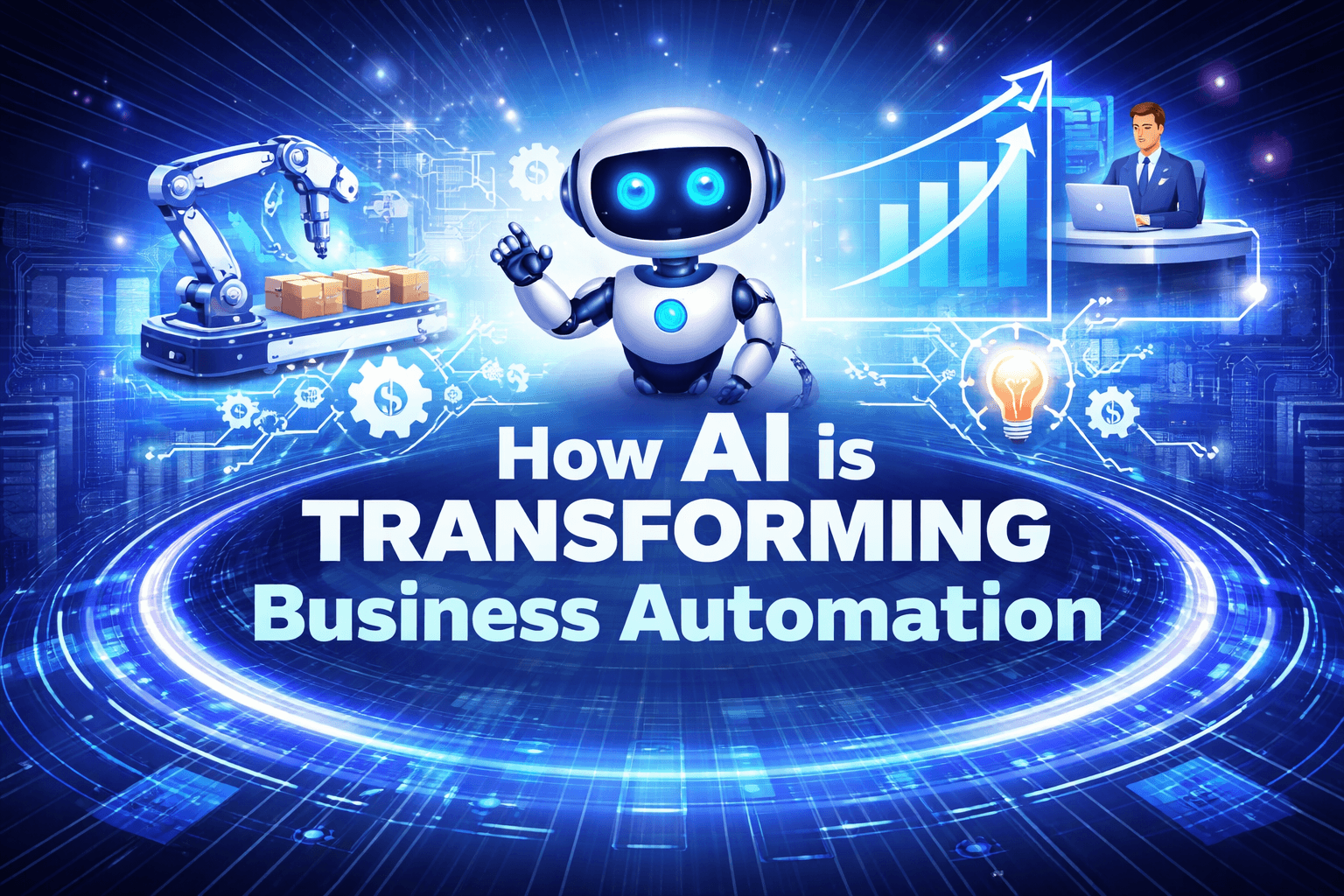
A Visual Look at AI Automation in Business
AI-powered automation is redefining how organizations run their day-to-day operations by enabling systems to understand data, make decisions, and execute workflows autonomously. :contentReference[oaicite:0]
Automation Used to Be About Control
For years, automation was built on predictability. Businesses designed workflows with clear rules, ensuring that every step followed a defined path. While effective for structured tasks, this approach struggled when processes became more dynamic or required judgment.
AI introduces a different model. Instead of relying solely on predefined rules, systems can now interpret context and adapt to variations. This allows automation to extend into areas that were previously considered too complex or unpredictable.
The First Real Impact: Removing Invisible Work
One of the earliest and most meaningful impacts of AI automation is the removal of what might be described as invisible work. These are the repetitive, often overlooked tasks that accumulate over time—validating data, formatting outputs, responding to routine inquiries, or cross-checking information across systems.
AI systems are particularly effective in these areas because they can process large volumes of data quickly and consistently. As a result, teams begin to experience a shift not just in workload, but in how their time is allocated. Effort moves away from routine execution and toward more analytical and strategic activities.
Where AI Automation Becomes Strategic
As adoption matures, AI automation extends beyond isolated efficiencies and begins to influence entire business functions.
In operations, processes that once depended on manual coordination become continuous and self-regulating. In customer-facing environments, systems move from reactive responses to proactive engagement, anticipating needs and resolving issues before they escalate.
This transformation reflects a broader trend. AI is not simply supporting business processes; it is actively shaping how those processes are designed and executed.
The Shift from Tasks to Workflows
A defining characteristic of modern AI automation is the move from automating individual tasks to orchestrating complete workflows. Instead of optimizing one step at a time, organizations are connecting multiple stages into cohesive systems.
This shift has measurable impact. AI-driven automation programs have been shown to reduce operational costs by approximately 20–30% while improving efficiency by up to 40–60%, largely by minimizing manual intervention and accelerating execution. :contentReference[oaicite:1]
The significance of this is not just operational improvement, but structural change. Workflows become more resilient, less dependent on specific individuals, and better aligned with organizational objectives.
Human-AI Collaboration in Practice
Despite the increasing capabilities of AI, the most effective implementations emphasize collaboration rather than replacement. AI excels at handling repetitive, data-intensive tasks, while humans provide context, judgment, and strategic direction.
In practice, this leads to a redefinition of roles. Employees transition from executing processes to supervising systems, interpreting outputs, and making higher-level decisions. This shift often results in greater productivity, but it also requires organizations to rethink how work is structured and measured.
The Challenge of Adoption
While AI adoption is accelerating, results are not always immediate. A significant number of organizations have implemented AI tools, yet only a portion are seeing clear returns on investment. :contentReference[oaicite:2]
This gap highlights an important reality: adopting AI is not the same as integrating it effectively. Without clear objectives and alignment with business processes, automation initiatives can struggle to deliver meaningful value.
Successful implementations tend to focus on well-defined use cases, gradual integration, and continuous evaluation rather than large-scale, unfocused deployment.
From Efficiency to Strategic Capability
Historically, automation was primarily associated with cost reduction. AI expands this perspective by enabling new forms of value creation. Businesses are not only performing existing tasks more efficiently but also unlocking capabilities that were previously impractical.
This includes real-time decision-making, adaptive customer experiences, and the ability to operate at a scale that would be difficult to achieve through manual processes alone.
As a result, AI is becoming less of an operational tool and more of a strategic asset.
Closing Perspective
The impact of AI on business automation is often gradual and understated. It begins with small improvements—faster processing, fewer errors, reduced manual effort—but over time, these changes accumulate into something far more significant.
Organizations begin to operate differently. Processes evolve into systems, workflows become interconnected, and decision-making becomes more data-driven and responsive.
What makes this transformation particularly compelling is that it is not driven solely by technology, but by how businesses choose to integrate and apply it. Those that approach AI with clarity, discipline, and a focus on real value are the ones most likely to see its full potential realized.